
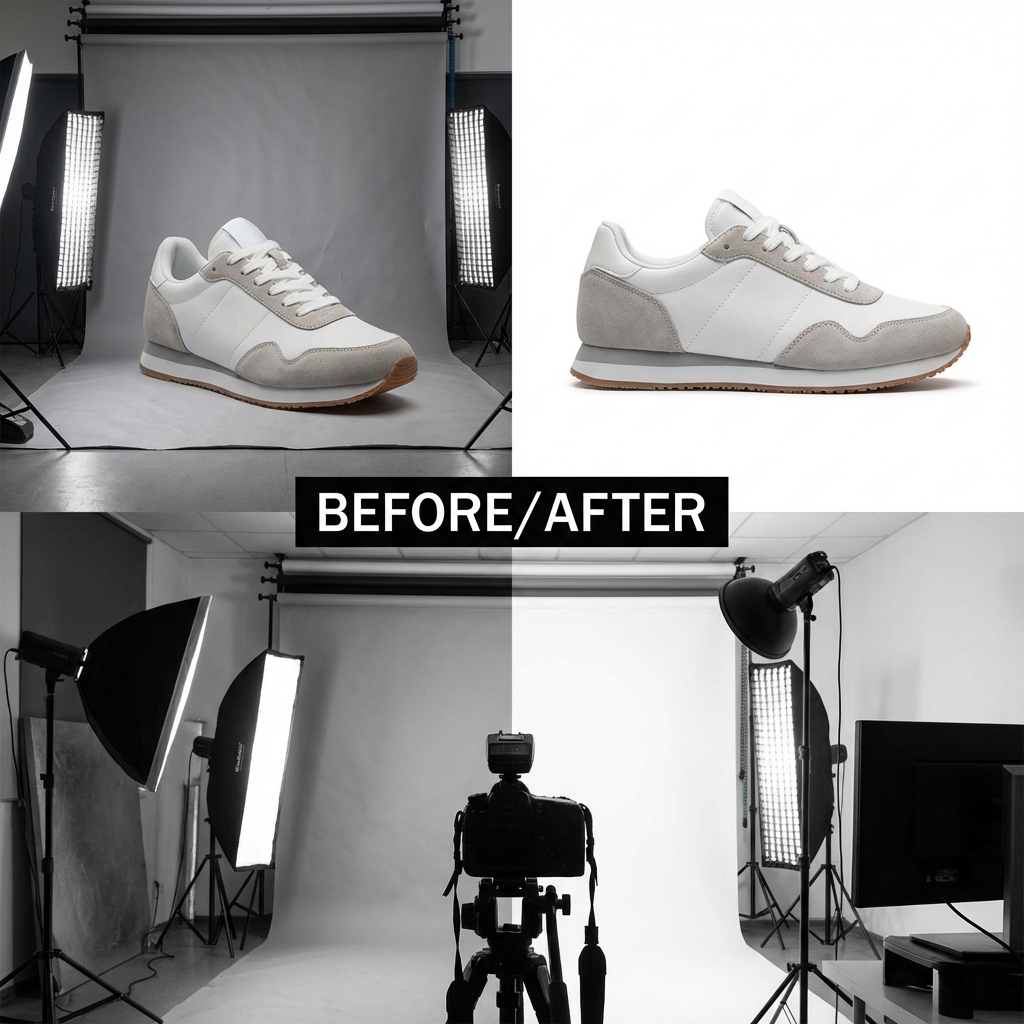
Why High-Quality Product Images Matter More Than Ever in 2025
In the rapidly evolving digital shelf of 2025, your product image is no longer just a visual reference—it is the only tactile experience a customer gets before purchasing. With attention spans shrinking to mere milliseconds and competition rising globally, a blurry, poorly lit, or generic photo is a guaranteed lost sale. Studies consistently show that 75% of online shoppers rely exclusively on product photos when deciding on a potential purchase. If your visuals don't communicate value instantly, your copyright and pricing strategy won't matter.
The Psychology of Visuals: Speed and Trust
Humans are inherently visual creatures. Neuroscience tells us that we process images up to 60,000 times faster than text. When a customer lands on your product page, they form a subconscious opinion about your brand's credibility within 50 milliseconds. A crisp, clean image with a pure white background signals trust, professionalism, and high quality. Conversely, shadows, clutter, distinct pixels, or inconsistent lighting scream "amateur" and trigger immediate hesitation or "bounce."
This psychological barrier is why photo editing is not just an aesthetic choice; it is a fundamental pillar of Conversion Rate Optimization (CRO).
Key Professional Editing Techniques for E-commerce
To compete with top-tier brands, your images need to undergo a rigorous post-production process. Here are the essential techniques that drive conversions:
1. Background Removal & Clipping Paths
The industry standard for major marketplaces like Amazon, eBay, and Google Shopping is a pure white background (RGB 255, 255, 255). This uniformity removes distractions and focuses the shopper's eye solely on the product. However, automated tools often fail around complex edges.
"Clipping path" service is the manual, pen-tool technique of cutting out an image with high precision. This ensures no jagged edges occur on complex shapes like:
- Detailed jewelry clasps and gemstones.
- Bicycle spokes and mechanical parts.
- Fuzzy textures like fur or hair strands.
2. The Ghost Mannequin Effect
For apparel retailers, the "Ghost Mannequin" or "Neck Joint" effect is a non-negotiable standard. By photographing a garment on a mannequin and then editing the mannequin out, you give the clothing a hollow, 3D shape as if worn by an invisible person.
Benefits of Ghost Mannequin:
- Better Visualization: Helps customers understand the fit, drape, and structure of the garment.
- Distraction-Free: Removing models prevents bias and focuses purely on the style of the cloth.
- Cost-Effective: Cheaper than hiring live models for every single SKU.
3. Color Correction & Colorways
Imagine buying a bright red dress and receiving a maroon one. Returns due to "color mismatch" are a massive logistics cost for e-commerce businesses. Professional color correction ensures the digital image on a calibrated monitor matches the physical product exactly under neutral light.
Furthermore, using "multi-clipping", you can shoot one item (e.g., a grey t-shirt) and digitally recolor it for every variant (blue, green, black). This saves thousands of dollars in photography costs while ensuring perfect consistency across your catalog.
4. Natural Shadow Creation
While the background should be white, the product shouldn't look like it's floating aimlessly in space. Adding a natural drop shadow or a reflection shadow grounds the object, giving it weight, depth, and realism.
- Drop Shadow: Simulates direct lighting from above.
- Reflection Shadow: Creates a sleek, high-end look often used for electronics, eyewear, and jewelry.
DIY vs. Professional Services: The Scalability Dilemma
Many small business owners try to edit photos themselves using free tools or basic AI removers. While AI is improving, it often misses the "human nuance"—retouching dust specs, smoothing wrinkles without making fabric look plastic, or handling translucent materials like glass.
For high-volume e-commerce businesses, partnering with a professional editing service ensures:
- Consistency: Every image looks like it belongs to the same brand family.
- Scalability: Edit hundreds of images overnight during peak seasons like Black Friday.
- Speed: Free up your internal team to focus on marketing and sourcing, not pixel-peeping.
Conclusion
In the digital marketplace, your photos are your storefront, your salesperson, and your product pitch all rolled into one. Investing in professional product photo editing isn't just an expense; it's a direct investment in your brand's integrity and your bottom line. Better images mean more trust, significantly fewer returns, and ultimately, higher sales figures.