The Classic Dilemma: Speed vs. Sustainability
Every small business owner with a limited marketing budget eventually faces the same fork in the road: "Should I pay for ads to get traffic now (PPC), or invest in content to rank naturally later (SEO)?"
It’s the digital equivalent of renting vs. buying a house. Both have massive advantages and significant drawbacks. The "best" investment depends entirely on your business model, your cash flow, and your growth goals. Let’s break down the pros and cons to help you decide.
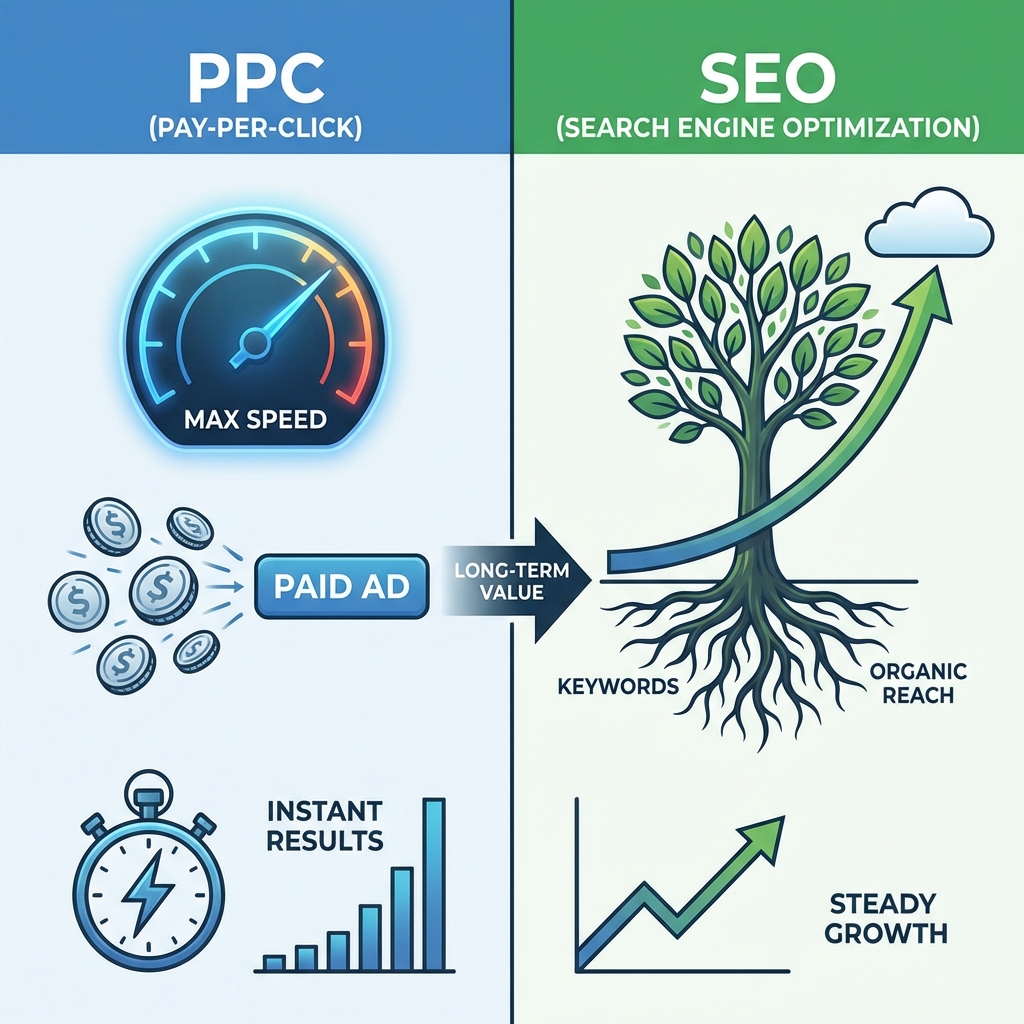
PPC (Pay-Per-Click): The Faucet
PPC platforms like Google Ads or Facebook Ads act as a faucet. You turn the handle (pay money), and the water (traffic) flows instantly. You turn it off, and it stops immediately.
Pros of PPC:
- Instant gratification: You can launch a campaign in the morning and get your first sale by the afternoon.
- Precision Targeting: You can target by specific zip codes, ages, incomes, and interests. You can show ads ONLY to "People searching for 'emergency plumber' in Manhattan."
- Agility: Testing a new product or offer? PPC gives you data instantly. You know within days if your idea is a winner or loser.
Cons of PPC:
- It's Expensive: Cost Per Click (CPC) is rising every year. In competitive industries like law or insurance, a single click can cost $50+.
- No Asset Building: You are renting attention. The moment you stop paying, your visibility drops to zero. You own nothing.
- Ad Blindness: Many users skip ads distinctively and trust organic results more.
SEO (Search Engine Optimization): The Garden
SEO is like planting an apple orchard. It involves digging holes, watering, and waiting. You might not see a single apple for a year. But once the tree grows, it produces fruit for decades with minimal maintenance.
Pros of SEO:
- Long-Term ROI: Once you rank #1, the traffic is essentially free. You don't pay every time someone clicks. This lowers your Customer Acquisition Cost (CAC) drastically over time.
- Credibility & Trust: 70-80% of users ignore paid ads and focus on organic results. Ranking high signals that you are an authority in your field.
- Compound Growth: Good content attracts backlinks, which boosts your domain authority, which helps your other content rank higher. It’s a snowball effect.
Cons of SEO:
- It's Slow: It typically takes 6-12 months to see significant traction. It requires patience and consistency.
- Uncertainty: You are at the mercy of Google's algorithm updates. A single update can wipe out traffic overnight if you utilize "black hat" tactics.
The Verdict: The Hybrid Approach
For most small businesses, the answer isn't "Either/Or"—it's "Both/And."
The Strategy: Use PPC to generate immediate cash flow and data while you build your long-term SEO foundation. Use the keyword data from your PPC campaigns to inform your SEO content strategy. Once your SEO traffic creates a reliable stream of leads, you can slowly dial back your PPC spend or reinvest it into new markets.
Don't rely 100% on rented land; build your own digital asset.